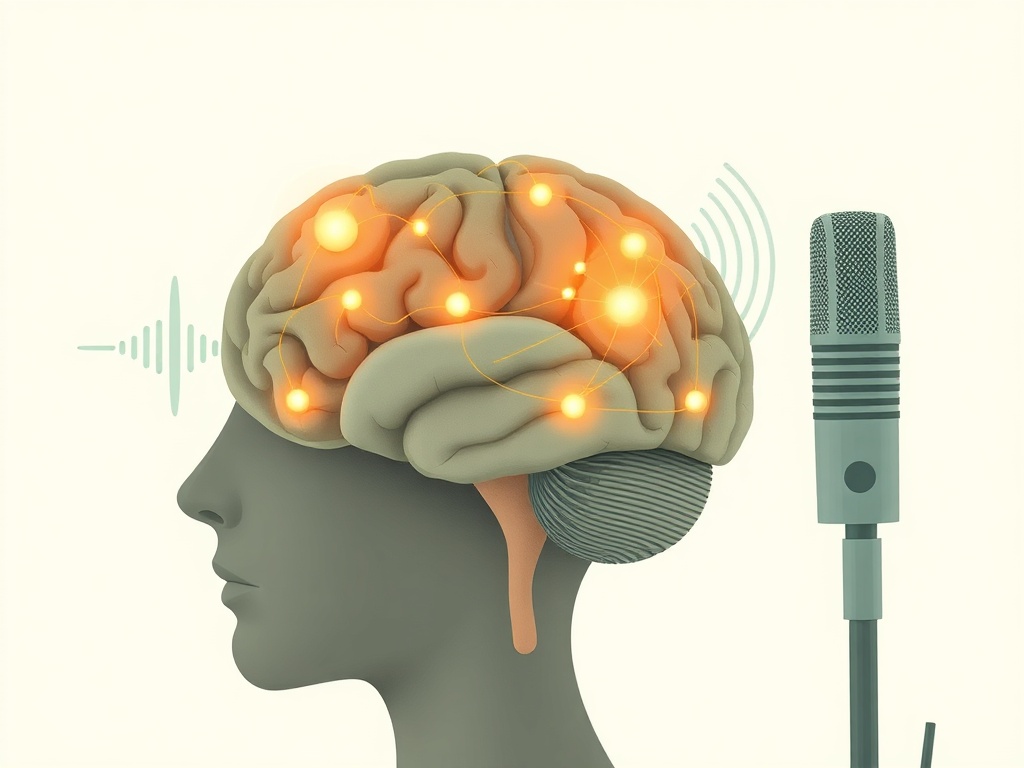
For the millions of adults who stutter, struggle with speech after stroke, or simply lose fluency under pressure, understanding why the brain sometimes fails to self-correct spoken output is not an academic question. New neuroimaging research identifies the precise neural architecture underlying the brain's real-time speech monitoring loop — findings with direct implications for diagnosing and treating fluency disorders.
The study, published in PNAS, used delayed auditory feedback (DAF) — a well-established paradigm in which speakers hear their own voice played back with a brief lag, reliably disrupting fluency — to probe individual variation in speech monitoring ability. By combining functional brain imaging during DAF exposure with structural neuroanatomical measures across participants, the researchers mapped both the activity patterns and the gray and white matter correlates that predict how strongly a given individual is disrupted. Key circuits implicated involve auditory-motor integration regions, including superior temporal and premotor cortices, where predicted and actual auditory signals are compared in a forward-model framework.
What makes this work notable is the individual-differences approach. Rather than simply confirming that DAF disrupts speech — long established — the team asked why some brains are far more vulnerable than others. This shifts the field from group-level descriptions toward personalized neuroscience of speech control. The structural correlates suggest that anatomical variation in auditory-motor pathways, not just momentary functional states, shapes fluency resilience. That said, this is likely a cross-sectional observational study with a relatively constrained sample, limiting causal inference. Whether the identified neural signatures predate fluency difficulties or result from them remains an open question. For clinical translation, the most exciting implication is the prospect of using structural brain markers to stratify stuttering severity or predict response to speech therapy — an incremental but genuinely useful advance in a field historically short on biological anchors.