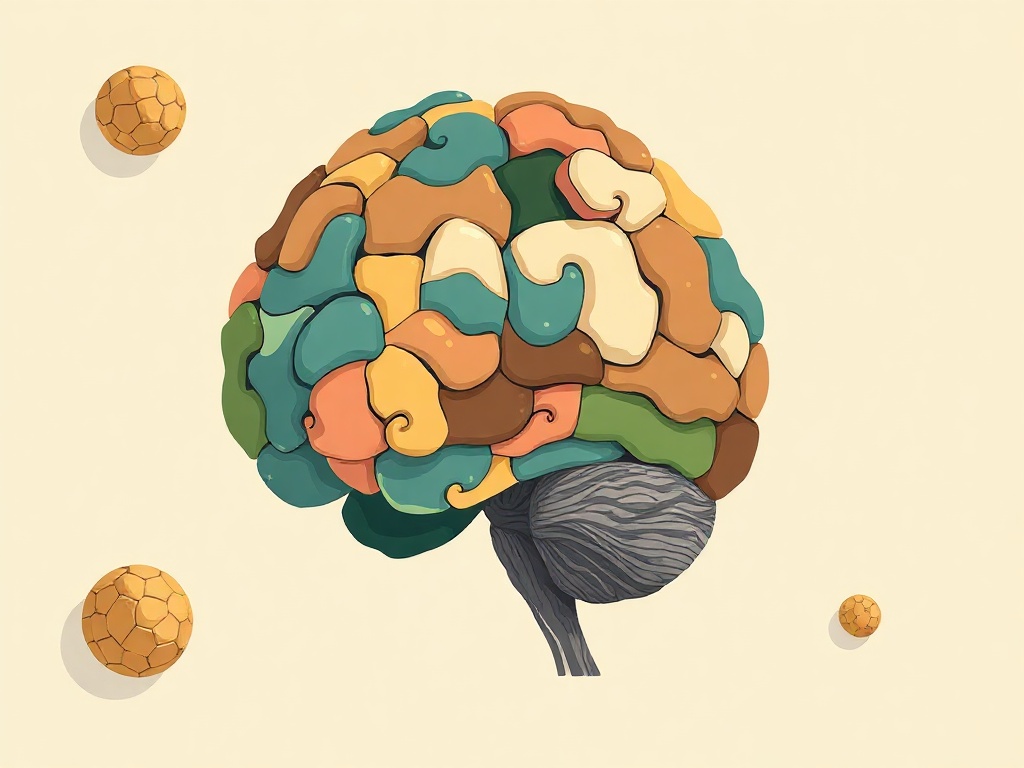
Everything we thought we knew about how the brain's command center is organized may need revision. For decades, neuroscientists have treated the lateral prefrontal cortex as a smoothly graded landscape of broad, overlapping functional zones — a framework that has shaped how clinicians and researchers interpret attention, decision-making, and cognitive control. New high-resolution imaging work challenges that picture fundamentally.
Using a precision fMRI approach with just 10 participants — each contributing roughly 8 hours of combined resting-state and task-based scanning — researchers mapped individual brain networks at a resolution that group-averaged studies simply cannot achieve. What emerged was not smooth gradients but a densely fragmented, interdigitated patchwork: distinct functional territories packed tightly alongside one another, with sharp boundaries invisible in conventional group data. Critically, despite high individual variability in exact patch location, conserved structural motifs appeared consistently across all participants. Task-based data confirmed that immediately adjacent patches handle radically different cognitive domains — language processing, social cognition, episodic future thinking, and domain-general executive control — each with functionally sharp borders.
This finding carries significant implications well beyond academic neuroscience. Group-averaged neuroimaging — the backbone of most fMRI research over the past 30 years — systematically blurs these fine-scale features because individual patch locations don't align across subjects. That means a substantial portion of the published literature on prefrontal function may reflect statistical artifacts of averaging rather than true biological organization. For brain health and clinical applications, this matters enormously: precision mapping could eventually improve targeting for transcranial magnetic stimulation, deep brain stimulation, or neurofeedback protocols aimed at specific cognitive functions. The study's limitation is its small sample size, making it discovery science rather than confirmatory. Nevertheless, the replication of conserved motifs across all 10 individuals is a meaningful signal. This is potentially paradigm-shifting work that should prompt the field to prioritize individual-level imaging over group aggregation.