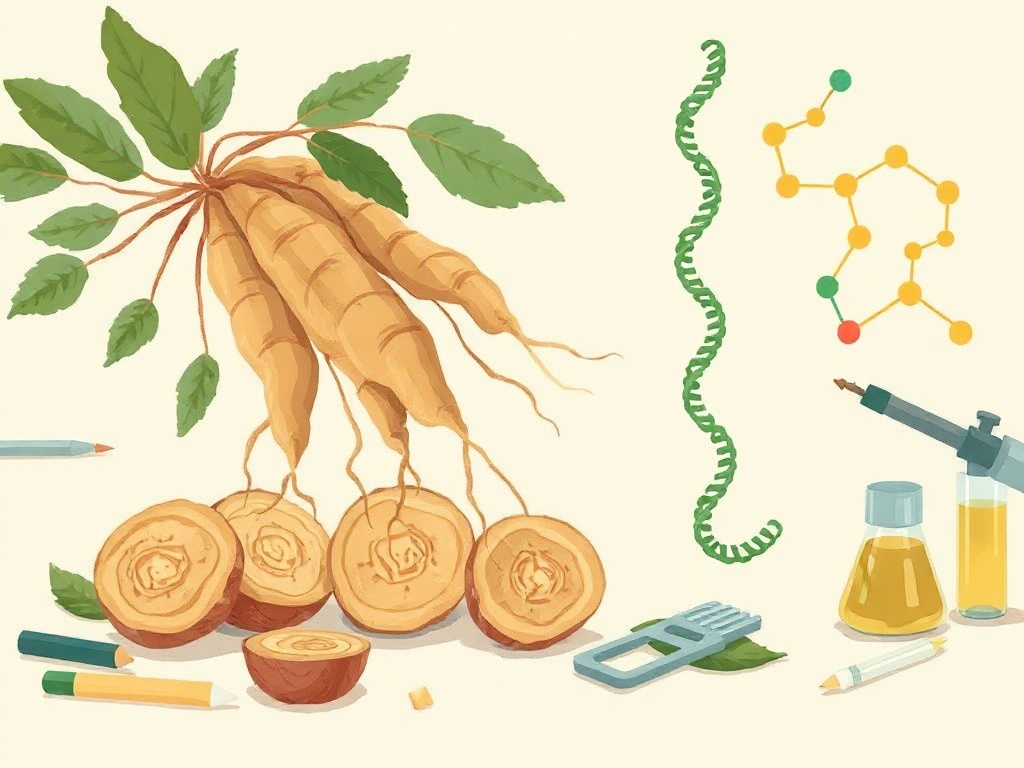
For anyone who takes ginseng supplements or follows adaptogen research, a fundamental question has lingered: why do cultivated and wild ginseng differ so markedly in their active compound profiles, and which genes actually govern that difference? A large-scale genomic study published in PNAS now provides the clearest molecular answer to date, with direct implications for the consistency and potency of commercially available ginseng products.
By resequencing 287 ginseng accessions spanning wild populations and domesticated cultivars, researchers identified five genetically distinct groups and traced the selective pressures that shaped them during domestication. Critically, they pinpointed specific genomic loci — including key enzymes in the triterpene saponin pathway — responsible for divergent ginsenoside profiles between wild and cultivated plants. The work maps how artificial selection inadvertently altered the ratio of individual ginsenosides, compounds whose biological activities (anti-inflammatory, neuroprotective, adaptogenic) differ substantially depending on their molecular structure, particularly the Rb1/Rg1 ratio that many researchers consider a proxy for therapeutic potency.
This finding sits at an important intersection of ethnobotany and precision medicine. Decades of ginseng clinical trials have produced inconsistent results, a problem frequently attributed to poorly standardized raw material. If specific alleles now identified as governing ginsenoside biosynthesis can be leveraged through marker-assisted breeding, the field could move toward chemotypically defined cultivars — essentially pharmaceutical-grade botanical starting material. That would meaningfully improve the reproducibility of future clinical trials. The limitation worth noting is that genomic architecture does not automatically translate to agronomic feasibility; breeding programs take years, and environmental factors like soil and altitude also modulate ginsenoside expression. Still, as genomic studies of medicinal plants go, a 287-accession dataset with biosynthetic pathway resolution is genuinely substantive — this is confirmatory of prior fragmentary evidence but represents a significant quantitative leap forward.