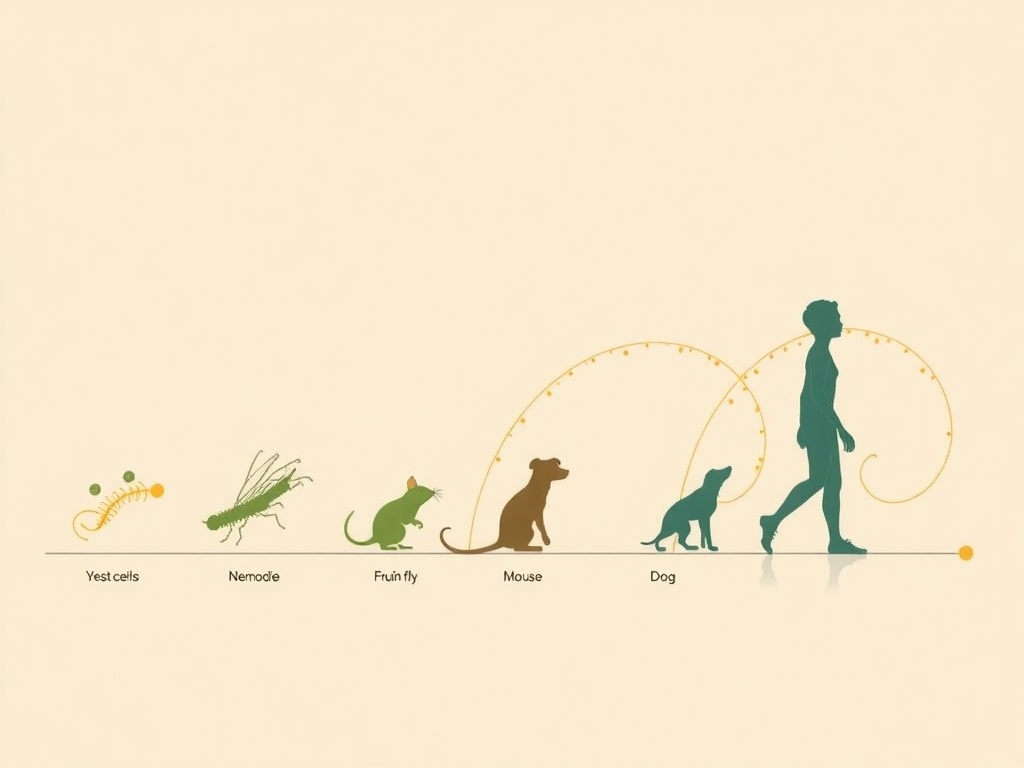
Understanding why humans live decades while fruit flies live weeks has challenged biologists for generations. A new mechanistic framework now offers a quantitative answer — and it reframes where longevity interventions may have the highest leverage. The finding matters because it shifts the conversation away from repair enhancement toward damage production as the primary driver of lifespan differences.
Using the saturating removal model — a stochastic mathematical framework that tracks damage accumulation and clearance — researchers fit survival data across eight well-studied species spanning organisms as short-lived as yeast and as long-lived as humans. Most model parameters, including the ratio of removal rate to noise amplitude and the death threshold, were remarkably conserved across species. The single parameter that varied most dramatically — spanning seven orders of magnitude — was the rate of damage production. The model also revealed two mechanistically distinct aging regimes: a "ballistic" regime, where damage accumulates faster than it can be cleared (characterizing yeast, nematodes, fruit flies, and mice), and a "quasi-steady-state" regime, where damage oscillates around a balanced production-removal set point that drifts upward over time (characterizing humans, dogs, guinea pigs, and cats).
This bifurcation has real implications for how we interpret longevity research. The majority of model organisms used in aging science — worms, flies, mice — fall into the ballistic regime, where interventions that slow damage production or enhance removal can yield large lifespan gains. Humans, however, appear to age quasi-steady-state, meaning the same intervention logic may not translate directly. This could help explain why many pro-longevity findings in short-lived organisms have failed to replicate clinically. The study is theoretical and awaits experimental validation, but as a comparative aging framework it is potentially paradigm-shifting — providing a principled basis for predicting which findings will and will not cross the species boundary.